Quartett Digithalia
 March 2026
Quartett Digithalia
 Other projects
 Schauspielhaus Foyer 3. Rang




Information
More details
The following works can be visited free of charge at any time during the festival. Whether in combination with a performance or on its own as a tour through a theater of the future – it’s worth coming by! …
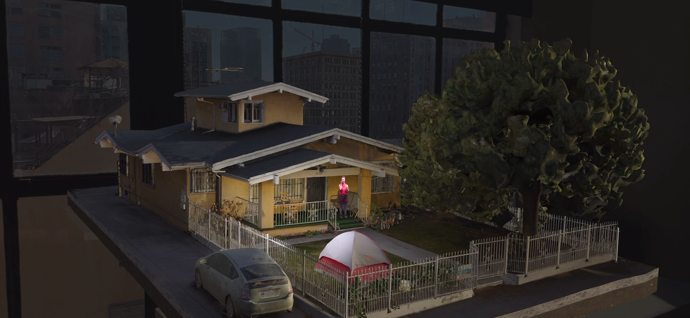
THE TENT: AN AR STORY
Augmented Reality Film
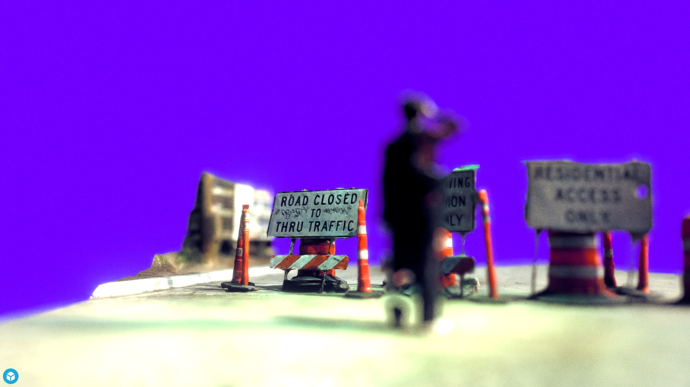
A woman wakes up one morning to find that a mysterious tent has appeared in her front garden. What to make of it? Inspired by author Martha Marion, “The Tent” is a 22-minute fairytale-like AR experience that explores the relationship between squatters and homelessness. With humor and emotion, director Rory Mitchell explores interpersonal dynamics and raises questions about responsibility and guilt, power and privilege. Developed using volumetric video and photogrammetry, it allows the audience to explore a miniature world from every perspective, creating a movie in which you can move freely. “The Tent” is a drama, a satire, a small bourgeois fever dream and a fable for society.
By Rory Mitchell
DP-/Immersive-Capture Sébastien Hameline
Production company The Mercantile Agency
Premiere SXSW 2024 Film & TV Festival, Austin, Texas
Awards Silver medal for the best story/narrative at XR Must 2024
The project celebrated its world premiere at the SXSW 2024 Film and TV Festival. The work was subsequently shown at international film festivals, with screenings in Paris, Shanghai, Seoul and Toronto, among others.
WORLD WIDE WIKI
Showing HTTP 451 & The Last Entry
What remains when free knowledge comes under pressure? At “DIGITHALIA”, “World Wide Wiki” presents web-based artistic research from a cross-location cooperation between Schauspielhaus Graz, ARGEkultur Salzburg and HAU-Hebbel am Ufer Berlin. The starting point is the 25th anniversary of Wikipedia – a symbol of free knowledge and at the same time a threat to it through AI use, political attacks and censorship. The projects examine how endangered knowledge is preserved, shared or made to disappear and what role theater can play in this.
With works by eeefff, Gold Extra, Kronberger & Kronberger, Chinedum Muotto, Nina Vasilchenko, Planetenparty Prinzip and SOAP
HTTP 451
Interactive game format
What disappears when no one is looking? With “HTTP 451”, the Graz-based collective “Das Planetenparty Prinzip” creates a dystopian game format about the slow disappearance of the free internet. As an interactive text adventure, the performance leads through a network that is increasingly forgotten, restricted and manipulated. Content can no longer be found, is legally blocked, deleted or locked – error codes such as 404, 410 or 451 become the dramaturgical engine of a collective experience.
The audience becomes part of a cross-audience rescue operation: everything that still exists must be backed up, copied and archived before the last entry disappears. But it quickly becomes clear that this is about more than just data backup. “HTTP 451” poses an uncomfortable question: What is worth preserving at all? Everything? Only certain content? The idea of a free network? The truth – or its distortions and lies?
Playful, humorous and at the same time highly political, the work makes it possible to experience how memory, knowledge and the public sphere are negotiated when digital spaces become fragile. “HTTP 451” is an interactive experiment about responsibility in the digital space – and about the need to take action before disappearance becomes the norm.
The Last Entry
VR performance
With “The Last Entry”, SOAP is dedicated to individual experiences of (data) loss on the Internet. The Internet, still staged as an inexhaustible archive of collective knowledge, proves to be an unstable and selective dispositive of digital memory: platforms are abandoned, archives closed, data deleted – decisions that actively determine the continued existence of digital spaces, and whose loss means a considerable cut in digital culture, creativity and social interaction.
The disappearance on the net is no coincidence; it has become political and is the result of economic interests, political interventions and algorithmic decisions.
In the form of a performative memorial site in VR Chat, SOAP creates a resonance space with “The Last Entry”, which combines documentary practice, digital performance and collective participation into a walk-in landscape of remembrance in which personal experiences of absence overlap and a new awareness of digital transience emerges.
Conception & implementation SOAP (Uwe Brunner, Bettina Katja Lange)
ON THE INTERNET, NOBODY KNOWS YOU’RE A DOG
Interactive essay game
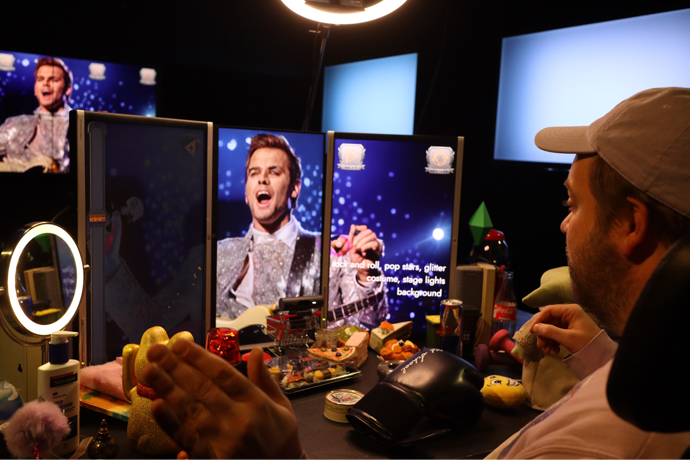
In her research “On the Internet, nobody knows you’re a dog”, Theresa Reiwer and her team examine the digital double – the images we create of ourselves in virtual spaces and the skins we slip into.
How does AI come into play here, how does it categorize and transform us? Can we break down reproduced stereotypes – in a world that is not actually bound by worldly constraints? In their live video installation, beauty culture meets bro culture. In the distorting mirror of filters, the users search for a way out that takes them back to the beginnings of the web.
By Theresa Reiwer (concept, text, direction)
Concept, creative coding David Egger
Creative coding Alexandre Ribeiro Lima Silveira
Voice Annette Holzmann
Created in 2025 as part of Konsole_Lab, Schauspielhaus Graz
THE CARING MACHINE
Video installation
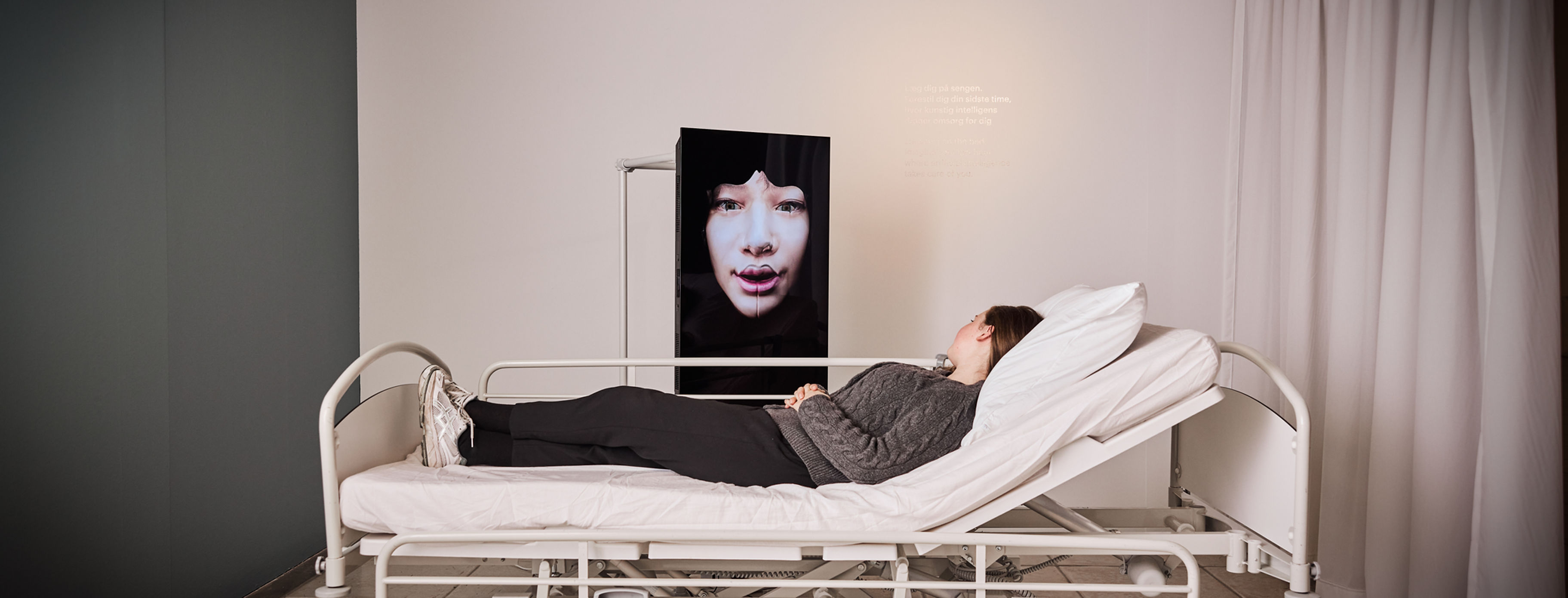
Imagine a future in which artificial intelligence accompanies us from the cradle to the grave! In “The Caring Machine”, we lie on our deathbed. A loving digital companion “sits” by our side, watching over us and speaking to us in a soothing voice. What does a future look like in which artificial intelligence takes on caring tasks in a growing healthcare sector? Is artificial intelligence a reassuring presence or a stark reminder of how much technology has permeated even our most intimate moments? “The Caring Machine” explores how emotional relationships between humans and machines in the future could challenge our notion of who – or what – we share our most intimate moments with. As more and more data sets accumulate and artificial intelligence gets better at reading human facial expressions and emotions as well as simulating emotional intelligence, we need to consider how we can build meaningful relationships not only with machines, but also with each other: Can a machine take on caregiving tasks or does this require something uniquely human that cannot be replaced by a machine?
By Cecilie Waagner Falkenstrøm
Production ARTificial Mind, Cecilie Waagner Falkenstrøm
Artist & UX designer Cody Lukas
Assistant artist Asbjørn Olling
Software engineer Vincent Olesen
Premiere 2024, Trapholt, Kolding, Denmark